AnalysisUpcoming
MPIS vs National EMR: A Functional Gap Analysis
Mapping documented MPIS functionality against the capability set a national hospital EMR is expected to deliver, and marking where the public record is silent.
Not yet published
Independent editorial publication
Do we have a RM 1.2billion scam / scandal / crony job for our National EMR project now in Malaysia ?
Start here
No jargon. Four short answers that explain what is being decided, what already exists, and what has not been explained in public.
0. What is this actually about?
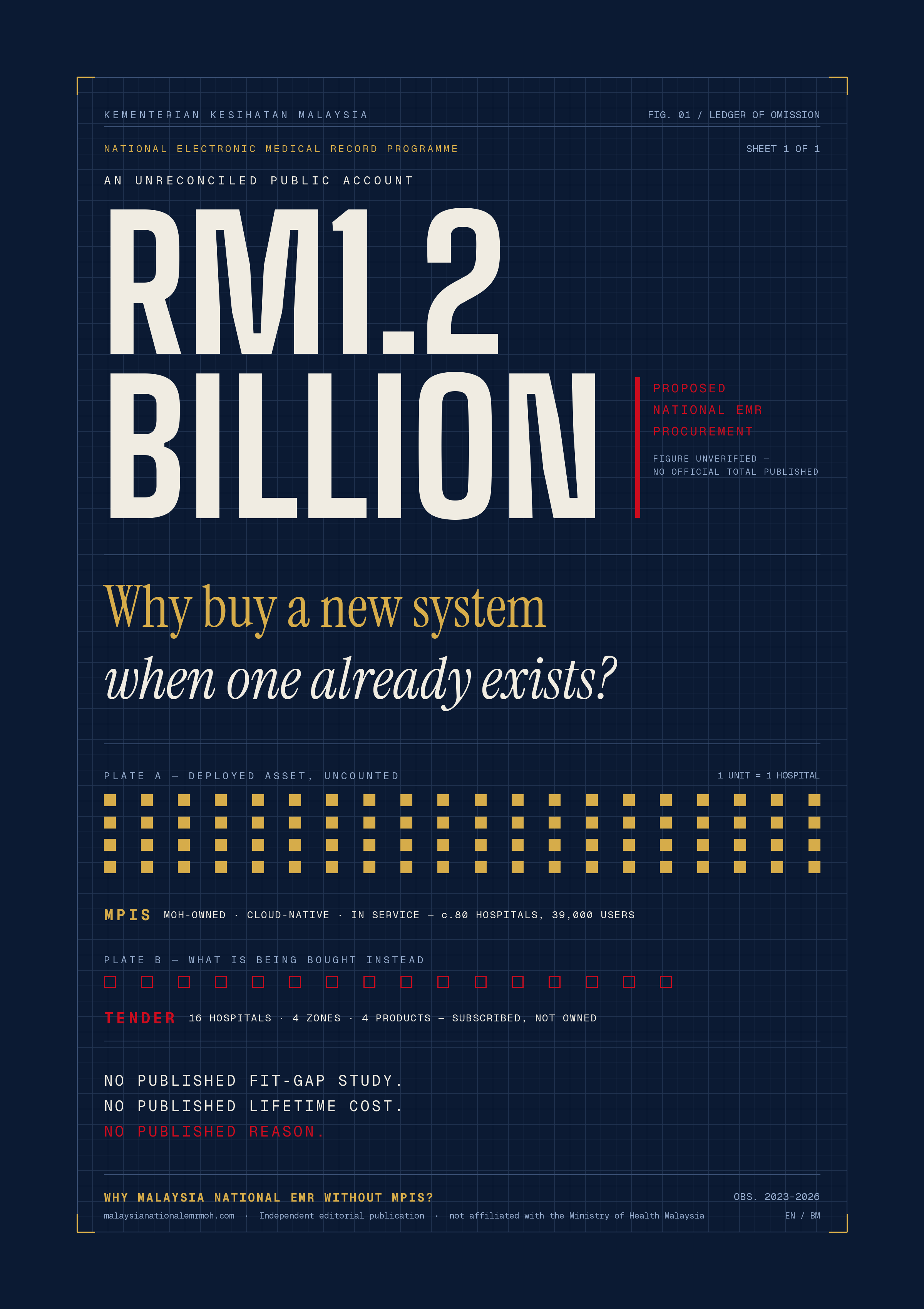
Malaysian public hospitals are moving from paper files to electronic medical records. The Ministry of Health already built and rolled out its own hospital system, MPIS, across dozens of hospitals. It is now planning to buy different, commercially owned systems instead. Nobody has publicly explained why the system taxpayers already paid for is not being upgraded and extended first.S1S3
Bahasa MelayuHospital awam Malaysia sedang beralih daripada fail kertas kepada rekod perubatan elektronik. Kementerian Kesihatan telah pun membina dan melaksanakan sistem hospital miliknya sendiri, MPIS, di berpuluh-puluh hospital. Kini kementerian merancang untuk membeli sistem lain yang dimiliki secara komersial. Tiada penjelasan awam mengapa sistem yang telah dibayar oleh pembayar cukai tidak dinaik taraf dan diperluas terlebih dahulu.
1. What is MOH trying to do?
Buy off-the-shelf cloud EMR systems on a subscription model, scaled nationally across four zones using four different EMR products, starting with an initial procurement covering 16 hospitals. Public reporting describes this as a large, multi-year national spending programme. Every ringgit spent on renting software is a ringgit not spent on beds, staff, medicines and waiting lists — so the size of the bill matters.S2S3
Bahasa MelayuMembeli sistem EMR awan siap pakai secara langganan, dilaksanakan di peringkat nasional merentasi empat zon menggunakan empat produk EMR berbeza, bermula dengan perolehan awal yang meliputi 16 hospital. Laporan awam menggambarkannya sebagai program perbelanjaan nasional yang besar dan berbilang tahun. Setiap ringgit yang dibelanjakan untuk menyewa perisian ialah ringgit yang tidak dibelanjakan untuk katil, kakitangan, ubat dan senarai menunggu — jadi jumlah bilnya penting.
Figures circulating publicly put the eventual national EMR programme in the region of RM1 billion. This publication has not been able to verify a single official contract value for the full programme, so no total is stated here as fact. Publishing the expected lifetime cost is one of the questions put to MOH below.
2. What is MPIS — and why does it count?
MPIS is the ministry's own cloud-native, multi-tenant hospital platform. It grew out of the COVID-19 CPRC Hospital system, was rebranded in 2023, and now handles registration, wards, clinics, pharmacy, laboratory and imaging links, medical records and revenue functions. Public and vendor material describes it as reaching more than 2.5 million registered patients, over 39,000 users and around 80 hospitals at varying levels by 2024. That is not a pilot. That is a working hospital information system.S1S8S7S10
Bahasa MelayuMPIS ialah platform hospital milik kementerian sendiri yang berasaskan awan dan berbilang penyewa. Ia berkembang daripada sistem CPRC Hospital semasa COVID-19, dijenamakan semula pada 2023, dan kini mengendalikan pendaftaran, wad, klinik, farmasi, pautan makmal dan pengimejan, rekod perubatan serta fungsi hasil. Bahan awam dan vendor menyebut lebih 2.5 juta pesakit berdaftar, lebih 39,000 pengguna dan kira-kira 80 hospital pada pelbagai tahap menjelang 2024. Itu bukan projek perintis. Itu sebuah sistem maklumat hospital yang berfungsi.
3. So why not develop MPIS further?
That is the unanswered question. MOH was still tendering for MPIS support and maintenance in 2026, so the platform is alive and funded. Yet in the major public explanations of the new national EMR direction, MPIS is not presented as the existing asset to assess first for expansion, enhancement or reuse. No published fit-gap study shows what MPIS cannot do that a purchased system can. And unlike MPIS, a subscription product is not owned by the ministry — the data stays public, but the software, roadmap and renewal price do not.S4S3S2
Bahasa MelayuItulah persoalan yang belum dijawab. KKM masih membuka tender sokongan dan penyelenggaraan MPIS pada 2026, jadi platform itu masih hidup dan dibiayai. Namun dalam penjelasan awam utama mengenai hala tuju EMR nasional yang baharu, MPIS tidak dikemukakan sebagai aset sedia ada yang perlu dinilai dahulu untuk diperluas, dipertingkat atau digunakan semula. Tiada kajian jurang (fit-gap) yang diterbitkan menunjukkan apa yang tidak mampu dilakukan MPIS berbanding sistem yang dibeli. Dan tidak seperti MPIS, produk langganan bukan milik kementerian — datanya kekal awam, tetapi perisian, peta jalan dan harga pembaharuan tidak.
Key facts
Every figure below carries a source indicator. Click a marker to read the reference and how much weight it carries.
~80S8
Hospitals using MPIS fully or modularly
By August 2024, according to the UGM visit report; 13 described as comprehensive.
Figures refer to varying levels and modules of MPIS deployment and should not be interpreted as 74–80 fully paperless hospitals.
Comparison
What is already deployed, set beside the direction described in public statements from 2025.
This comparison describes strategic direction as reflected in public material. It is not a conclusion that MPIS is automatically superior to a procured commercial system, nor that the new direction is wrong. It is a statement of what exists today alongside what is being planned.
The stated position
The public rationale for the new EMR direction, quoted as reported, alongside what those statements do not address.
We are not going to build systems anymore.
Reporting by CodeBlue and Healthcare IT News in 2025 sets out the direction in the division director's own terms: Malaysia should buy off-the-shelf cloud EMR products on a subscription model rather than develop systems internally, because internally developed systems were described as reaching end-of-lifecycle and the ministry was described as lacking the capacity to keep pace with technology change. The same statements set out One Record, One Citizen, four zones running four EMRs, an initial procurement covering 16 hospitals, and FHIR and HIMSS EMRAM as guiding frameworks.S2S3
The editorial observation is narrow and should be read precisely. In these major public explanations of the future architecture, MPIS — the ministry's own cloud-native, multi-tenant hospital platform, still under active maintenance tender in 2026 — is not prominently presented as the existing asset to be assessed first for expansion, enhancement, integration or reuse. That is an observation about the public statements reviewed here. It is not a claim that MOH has never mentioned MPIS, nor that any official holds no internal view of its future.S4
Flagship
Policy / Investigation · 14 min read
Malaysia has already built, deployed and expanded a hospital information platform across scores of government hospitals. As the country moves towards procuring off-the-shelf cloud EMRs, that platform is barely present in the public conversation about the future architecture.
Editorial Desk · 14 August 2026
Chronology
The documented sequence of MPIS development alongside the public shift in national EMR direction.
COVID-19 era
The platform that became MPIS has its roots in the CPRC Hospital system developed during the COVID-19 pandemic response.S1
February 2021
Public sector material records the introduction of patient management functionality, moving the platform beyond pandemic data collection.S1
2022
MPIS was implemented at Hospital Tanjong Karang, covering 114 beds within two weeks. By the end of 2022, 17 hospitals had implemented the Patient Management component.S1
February 2023
Approval was obtained for further expansion, and CPRC Hospital was rebranded as the Medical Programme Information System (MPIS).S1
Q1 2024
Public MOH material reported more than 2.5 million registered patients, more than 39,000 users, 74 hospitals using Patient Management, eight hospitals with comprehensive implementation, 66 undergoing progressive implementation, and seven operating MPIS alongside legacy systems.S1
August 2024
A report following a visit to MOH described around 80 hospitals using MPIS fully or modularly, with 13 using it comprehensively at that stage, and referenced a wider 149-hospital implementation ambition.S8
Why this matters
Public money has already been committed to building, deploying and supporting an operational platform. Whether that investment is extended or written off should be a documented decision.
Millions of registered patient records exist inside current systems. Their migration, integrity and accessibility are clinical safety issues, not just technical ones.
Years of configuration, workflow knowledge and local adaptation live inside a deployed system and inside the teams that run it.
Procuring capability that already exists and functions is the most avoidable category of public IT waste.
Cutover in live hospitals carries operational and clinical risk that rarely appears in headline procurement pricing.
Subscription pricing, interfaces, training, change management and parallel running determine real lifecycle cost far more than licence headline figures.
Multiple procured EMRs must exchange data reliably, or the country replaces one generation of silos with another.
The ability to build, adapt and maintain public health systems domestically is a strategic capability, and it is easier to lose than to rebuild.
Accountability
Ten questions that a published assessment would resolve. None of them require confidential information to answer.
On the record
Coming next
Scoped but not yet published. Nothing here is presented as completed reporting.
Mapping documented MPIS functionality against the capability set a national hospital EMR is expected to deliver, and marking where the public record is silent.
Not yet published
Zonal procurement can accelerate delivery or entrench fragmentation. What the reported four-zone approach implies for patients who move between regions.
Not yet published
The cost question nobody has answered publicly: what development, integration and support of the existing platform would require over a full lifecycle.
Not yet published
A document-by-document reading of how Malaysia's hospital digitalisation direction has been publicly described, and what remains unpublished.
Not yet published
FHIR is a standard, not a strategy. What has to be true beyond the standard for records to actually follow a patient across systems.
Not yet published
Beyond health: how public sector systems are inventoried, valued and reused — and what a reuse-first policy would require in practice.
Not yet published
Evidence
Official, hospital-level, academic, media, training and vendor material, each labelled by type.
MOH / MyGovCloud
Public sector presentation material reporting MPIS deployment figures, module scope and architecture as at Q1 2024. A stable public URL for this deck was not verified at the time of writing, so it is listed here as a named document rather than an invented link. Readers holding a citable copy are invited to submit it.
No verified public URL
CodeBlue (Galen Centre)
February 2025 reporting of Digital Health Division statements on off-the-shelf cloud EMR procurement, subscription models and national scale-up.
Open sourceHealthcare IT News
Reporting from HIMSS25 APAC covering statements on ceasing internal system building, the One Record One Citizen direction, the four-zone / four-EMR approach and an initial procurement covering 16 hospitals.
Open source